

Get to the right product.
Clear categories, catalogue search and product descriptions help customers narrow down the materials they need.
FOR BUILDERS’ & TIMBER MERCHANTS
Help customers find the right material, understand the product and explore buying online. Start with your catalogue, your customers and the way your branch already works.
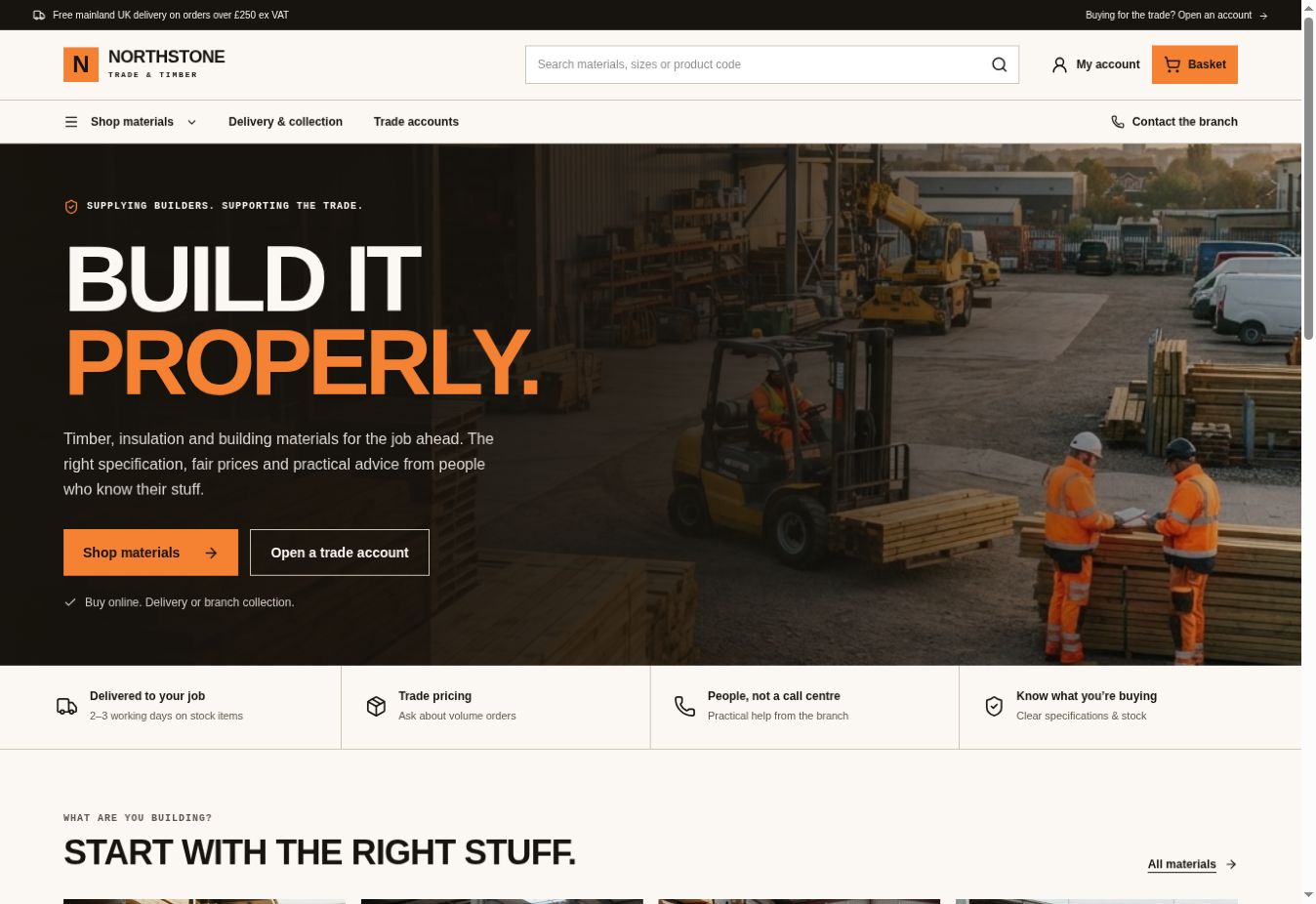 Explore the Northstone concept
TRY THE NORTHSTONE CONCEPT
Browse categories, search the sample catalogue, review specifications and prices, and add products to a basket.
Independent demonstration with sample products, stock and prices. Live stock, payments, trade-account rules and operational integrations require separate implementation.
THREE PARTS OF THE JOURNEY
Clear categories, catalogue search and product descriptions help customers narrow down the materials they need.
Specifications, pricing presentation and clear buying information support the decision. Any stock information needs an agreed, reliable source.
A basket, a suitable enquiry or a route to the branch should fit your trading rules and the way you fulfil orders.
BUILT AROUND YOUR OPERATION
Look at how products are organised, which questions customers ask and where the current website sends them next.
Check product data, stock systems, account pricing, payment and delivery requirements. Compatibility and access determine what can sensibly be connected.
That could be a website improvement, a catalogue experience or a connected workflow. The scope identifies what is included, what stays manual and how the result will be tested.
BEFORE WE START
Scope, costs and what happens next. Clear before you commit.
Projects are priced around the process, the tools involved and the work needed. After understanding the problem, we agree a written scope and price before implementation. Start by describing one task; you do not need a technical brief.
Implementation and ongoing costs are explained separately. Depending on the solution, there may be third-party software, hosting or usage charges. Maintenance or ongoing support is agreed separately, so you can see what you are paying for.
Timing depends on the scope, system access, available content and the testing needed. A delivery plan is agreed after discovery. The aim is a realistic schedule with clear review points, rather than promising a date before understanding the work.
That is the starting point. We assess compatibility, available integrations and access before recommending a solution. If an existing tool or a simpler change can solve the problem, that is considered first.
YOUR NEXT STEP
Tell Adrian about your merchant business, your website and the systems you use. We’ll explore a practical first improvement.