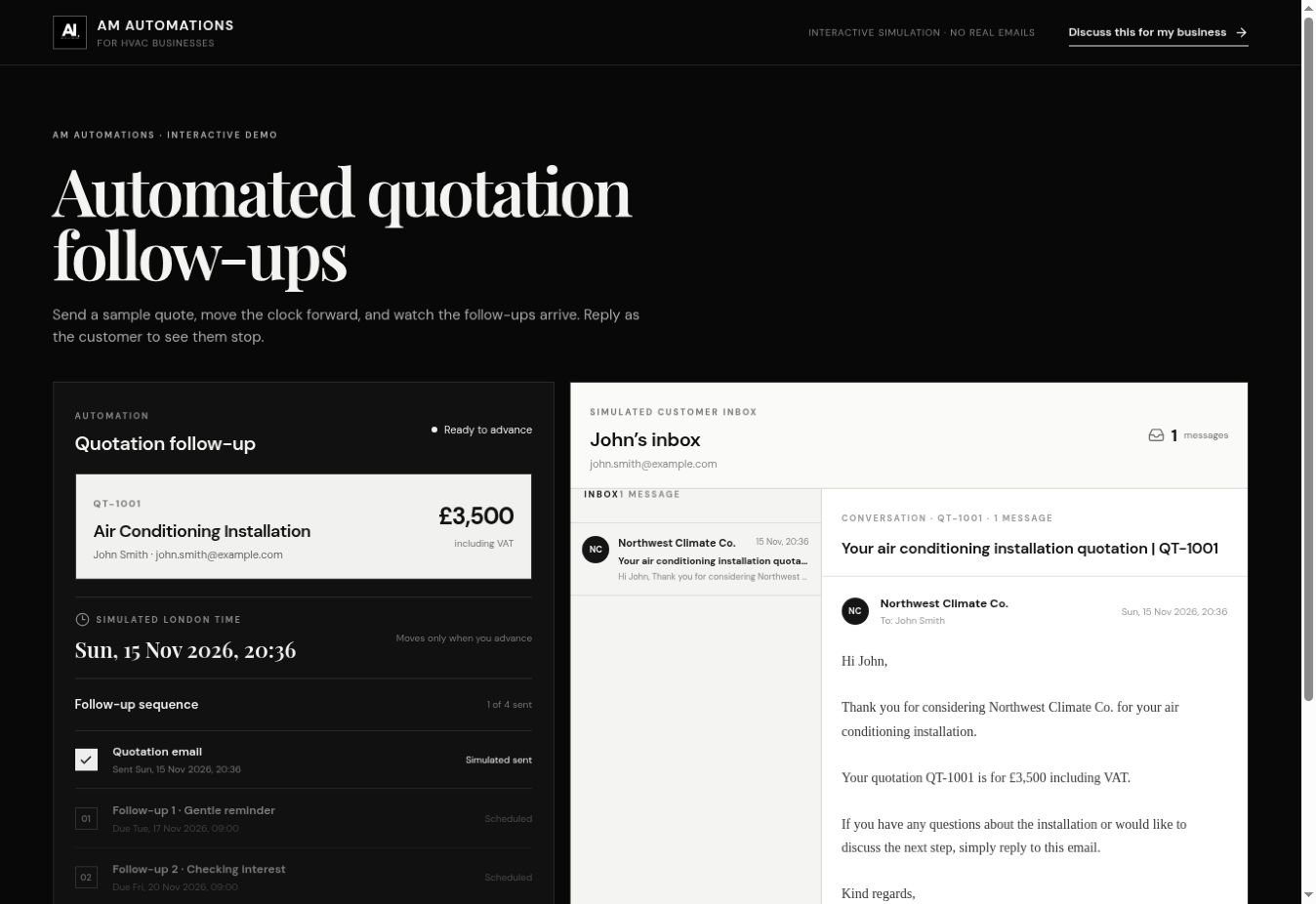
Automated Quotation Follow-Ups
See a quotation move through scheduled reminders, customer replies and a clear stopping point.
AUTOMATION FOR UK BUSINESSES
Websites, quotation follow-ups and connected systems—helping your team spend less time chasing customers, copying information and answering repeat questions.
Start with one task. No technical brief needed.
Explore the demonstrationsWorkflow complete: quotation accepted and future reminders stopped.
Founder-led. Built around the tools and processes you already use.
SEE THE WORK
Two independent demonstrations showing how a different process could work. Explore the project or try the demo directly.
View All WorkWHAT DO YOU WANT TO IMPROVE?
Three useful starting points. The details are shaped around your business, your tools and your team.
Give quotations a consistent follow-up, with clear rules for timing, replies and the next step.
Quotation reminders · Reply handling · Status updatesExplore this service 02Move information between the right tools and reduce the routine work your team repeats.
Data transfers · Document workflows · System connectionsExplore this service 03Help customers explore products, find useful information and reach the right place.
Websites · Trade e-commerce · Customer guidanceExplore this serviceTHE EVERYDAY FRICTION
We look at where the work gets held up, what can safely happen automatically and where a person should stay involved.
HOW A PROJECT WORKS
You do not need to choose the technology. We begin with the problem and agree what the work will involve.
Describe the current process, the tools involved and where work gets held up.
Set out the proposed workflow, responsibilities, price and delivery plan before building.
Review the implementation against agreed examples, including replies, failures and exceptions.
Walk through how it works, provide useful guidance and agree any ongoing support separately.
MEET ADRIAN
I’m Adrian McGhee, the founder of AM Automations, based in Greater Manchester. My background in sales and operations coordination informs how I approach the work: understand the task, consider the people using the system and keep the next step clear.
More About Adrian Run a builders’ or timber merchant?BEFORE WE START
Scope, costs and what happens next. Clear before you commit.
Projects are priced around the process, the tools involved and the work needed. After understanding the problem, we agree a written scope and price before implementation. Start by describing one task; you do not need a technical brief.
Implementation and ongoing costs are explained separately. Depending on the solution, there may be third-party software, hosting or usage charges. Maintenance or ongoing support is agreed separately, so you can see what you are paying for.
Timing depends on the scope, system access, available content and the testing needed. A delivery plan is agreed after discovery. The aim is a realistic schedule with clear review points, rather than promising a date before understanding the work.
That is the starting point. We assess compatibility, available integrations and access before recommending a solution. If an existing tool or a simpler change can solve the problem, that is considered first.
Ownership, account access and handover are set out in the written scope. Wherever practical, business accounts are held by your business. Any third-party subscriptions, licences and dependencies are identified before you commit.
The handover explains how to use the system, what to check and how exceptions are handled. Any monitoring, maintenance, improvements or ongoing support are scoped separately, with responsibilities made clear.
Yes. A clearly defined first process is a sensible starting point. We agree what success looks like, test it with your team and use what we learn to decide whether any further work is worthwhile.
YOUR NEXT STEP
Tell Adrian about one task, the tools you use and what you would like to happen. No technical brief needed.